
november 10th 1909 Ronald henry baugust to Sylvia Amelia louise spearman
deal, kent to balham, london
82 miles
the message
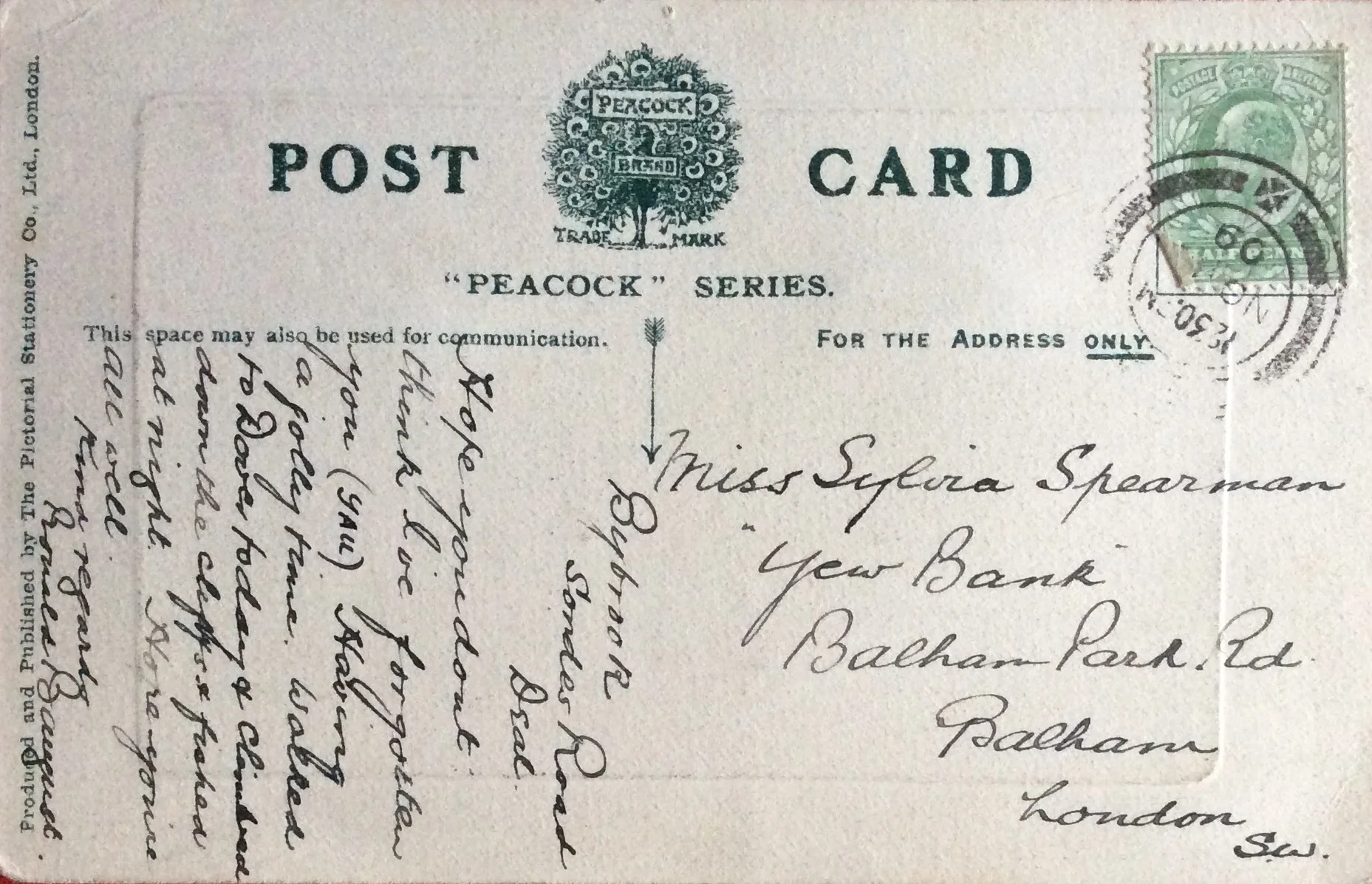
"Bybrook
Sondes Road
Deal
Hope you don't think I've forgotten you (YAU). Having a jolly time. Walked to Dover today & climbed down the cliffs & fished at night. Hope you're all well
Kind regards
Ronald Baugust"
the sender
Baugust is a very unusual surname. That meant that there were not many possibilities to choose from the census records. Ronald Henry Baugust (1891-1916) was the second of the five children of Henry Thomas Baugust (1862-?) and Clara Annie Bates (1862-?) who were both schoolteachers in Staffordshire. In 1911 Ronald was a bank clerk in Stoke. Tragically, in 1916 he was killed at the battle of the Somme during WWI. what is even more tragic is that his brother Lawrence John (1897-1917) was also killed at the Somme. And his elder brother Reginald (1890-1895) dies when he was 5 which meant that there were no male children to carry on the name of Baugust in this family. It is an unusual name.
the recipient
Sylvia Amelia Louise Spearman (1887-1981) was the daughter of Walter William Tudor Spearman (1851-1945) and Eliza Ada Mary Gough (1864-1957). William was a surveyor. In 1911, Sylvia was still living with her parents at the age of 24, but no occupation is given. In 1914 Sylvia married Francis Alfred Mason (1886-1958), a Foreign Correspondent and the son of Ibbott Alfred Mason (1844-1919), a clergyman, and Emily Warland (1859-1938). Sylvia and Francis had five children.
the places
Deal, Kent
Balham, London
Dover, Kent
what the card says to us
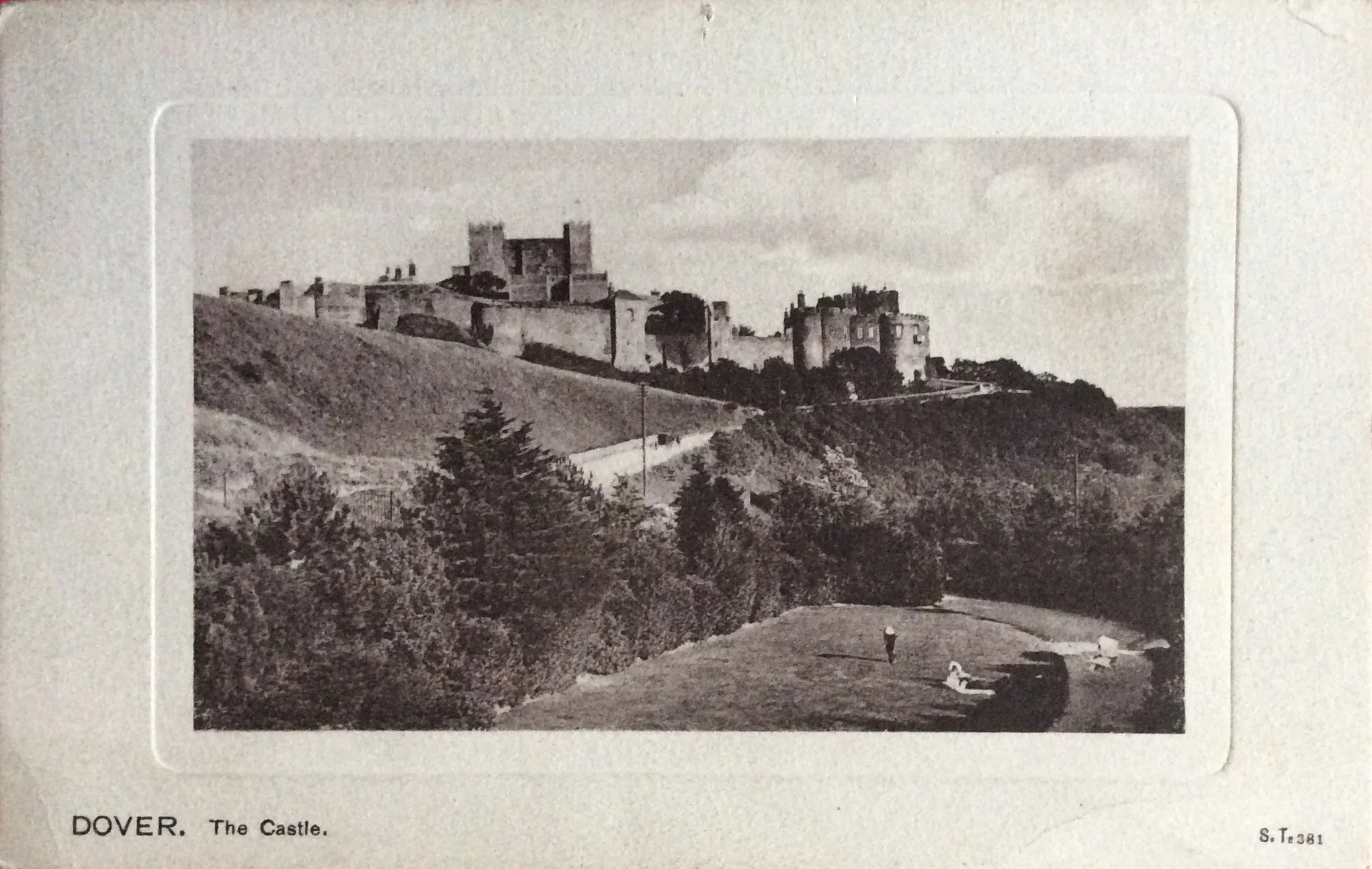
The picture is of Dover Castle (http://www.english-heritage.org.uk/visit/places/dover-castle/) which today is run by English Heritage. Dover is 8 miles from Deal from where the card was sent.
It is difficult to know when Ronald and Sylvia met as he was born and appears to have lived in Staffordshire while she is born and bred in South London. How did their paths cross?
And what does the inclusion of "YAU" in brackets mean. Was it a playful reference to Ronald's midlands accent? Were they romantically involved with each other around 1909? Whatever the case, it doesn't seem to have lasted with Sylvia marrying in 1914.
No record can be found of "Bybrook" in Deal. The assumption is that it was a guest hose and that Ronald was on holiday on the South coast. But it was November which makes that a bit unusual. And with Deal being an 8 mile walk from Dover, that would be quite a journey on a Winter's day. Perhaps they were made of sterner stuff in 1909. Ronald must have been very fit to have walked 8 miles and climbed down the cliffs. And furthermore, he spent the November night fishing. A fascinating insight into the life of an 18 year old young man in 1909 and who could have had no inkling of the fate that awaited him.
There is one more interesting thing about this card. It has been pinned up somewhere. Obviously it is impossible to say when or by whom. Or why.