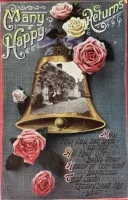
This is the eighth postcard in the Frances Mantz sequence. It wishes Frances luck for the week ahead at the Home and Colonial Training College for school mistresses.
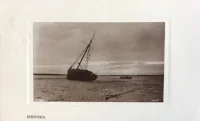
The Saga of Frances Mantz and Walter Newitt Part 7
This is the seventh card in the Frances Mantz sequence. A week after arriving in Newcastle, Frances sent a card to Walter in Bruges. There is no message.
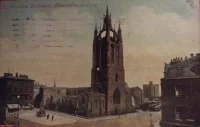
The Saga of Frances Mantz and Walter Newitt Part 6
This is the sixth card in the Frances Mantz series of 12. In it, we learn that Frances has travelled to Newcastle by boat. The reason is unknown.
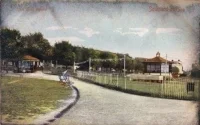
The Saga of Frances Mantz and Walter Newitt Part 5
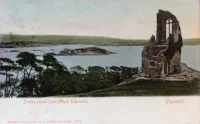
This is the fifth postcard in the Frances Mantz series. It is interesting for a couple of reasons. It seems to have been sent simply to provide an address in Plymouth. It is not clear what the significance of the address is. Is it a Guest House? Is it a rental property? It has not been possible to find out. It also raises the question of whether Frances or one of her circle intended a trip to Plymouth. Holiday or Business? Anything to do with the Temperance?
The Saga of Frances Mantz and Walter Newitt Part 4
This the fourth card in the Frances Mantz series. It is mirror written to her future husband Walter Newitt. It refers to the Temperance Movement and the Band of Hope.
The Saga of Frances Mantz and Walter Newitt Part 3
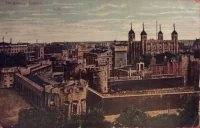
This is the third of twelve cards in the Frances Mantz series. It is written in mirror writing to her future husband who is studying to be a teacher about 20 miles away in Isleworth although it would appear that they have just spent the previous day, Sunday, together.
The Saga of Frances Mantz and Walter Newitt Part 2
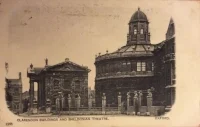
This is the second postcard in a series of 12 involving Frances Martha Mantz. It references an interesting building called The Abbey in Campden Hall Road, Kensigton which was badly damaged in an air raid in 1941 and demolished in the 50s.
The saga of Frances Mantz and Walter Newitt Part 1
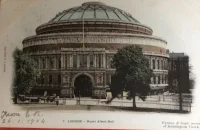
There are 12 postcards either sent by or received by Frances Martha Mantz between 1904 and 1907. Some of them also involve her future husband Walter Joseph Newitt.
This is the first card sent in August 1904 by Frances' younger sister Martha.
A Romantic Story Or A Fanciful Fabrication
Sometimes when you are digging around looking for information, a story suggests itself to you. That is the case with the 1908 postcard sent to Mary Emma Morris from someone called Jack. There is no concrete evidence to reveal who Jack was. However there is enough to build a romantic narrative of unrequited love, separation and reconciliation between two widowed sweethearts. It's probably wrong but it would be fantastic if it was right.
Frustrated by the address
In the 1913 Miss Young card (not to be confused with the 1904 Miss Young card which is probably to a completely different person although there seems to be something about that name that attracts problems for the researcher) the address is clearly written but does not seem to exist in the census. Presumably it still got to its intended recipient, but without being able to identify the person, further research has proved fruitless.
Is the fact that it was for 7A significant? Without knowing the type of building it is impossible to say.
This is all particularly frustrating because there seems to be so much going on in this card.
A signature is a personal thing
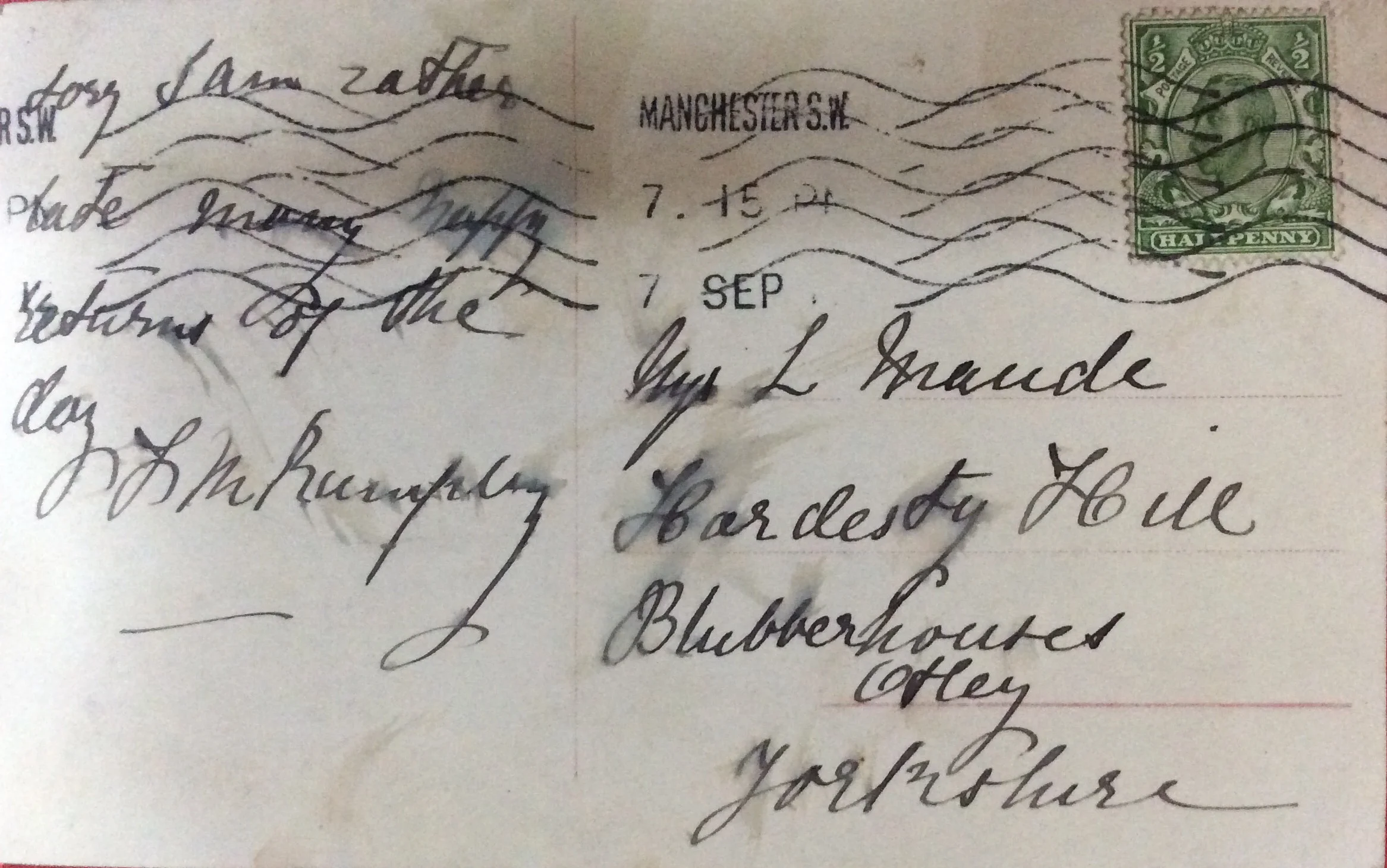
A person's signature is sometimes very personal. Sometimes the letters contained in it do not resemble their normal handwriting. It becomes a distinctive mark rather than a readable name. That is the case with the card sent to Albert Leuty Maude in 1912. See if you can decipher it.
A less than water tight case
Sometimes you have to take a chance and make a leap in order to identify the sender or receiver. that is the case with Flossie May Ferley, if that is indeed the recipient of the card. The problem with the census is that although it is powerful, it is only taken every 10 years and people do move, although not very far. In identifying Flossie May there has been a fair amount of detective work but I am very confident that it is right. The identity of the sender is much less solid.
celebrity memorabilia
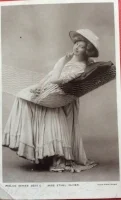
The two cards sent to Barbara Roberts in 1906 both have pictures of film stars on them. Not particularly well known by today's standards and one of them, Miss Ethel Oliver has at the very start of her show business career in 1906. These cards appear to be publicity shots put out by studios to promote their stars. The fact that Barbara was sent at least two suggests that she was a collector of celebrity memorabilia in the same way that modern day teenagers collect similar trivia. And they were kept. That fact suggests that although it has not been possible to trace Barbara beyond 1906, she lived a long life for the cards to turn up 110 years later. At least I hope that is what happened.
There are a couple of other mysteries surrounding the Ethel Oliver card. Who wrote "One Glove Lost" on the front of it and why? And was the patois used by "La Ian" a common thing in 1906?
Some Cards Look A Bit Creepy Today
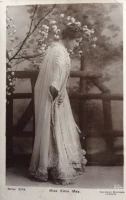
Take for example the 1916 Laura Florence Savage birthday card. The image is actually a bit disturbing to modern day eyes. You wonder what the target market was. But then you remember it was 1916 and probably quite innocent. Another example is the 1910 Nancy Brown card. It just looks creepy.
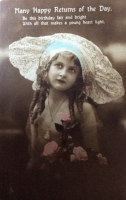
1916 Laura Florence Savage
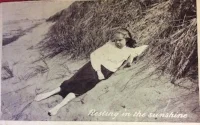
1910 Nancy Brown
Why Did This One Survive?
The postcard from Edith Charlotte Newman nee Flowers to her younger brother Frank James Flowers in 1902 is a totally unremarkable holiday postcard from Torquay. I don't understand why it is still around after 114 years. The answer may be that it is one of three postcards to the Flowers family.
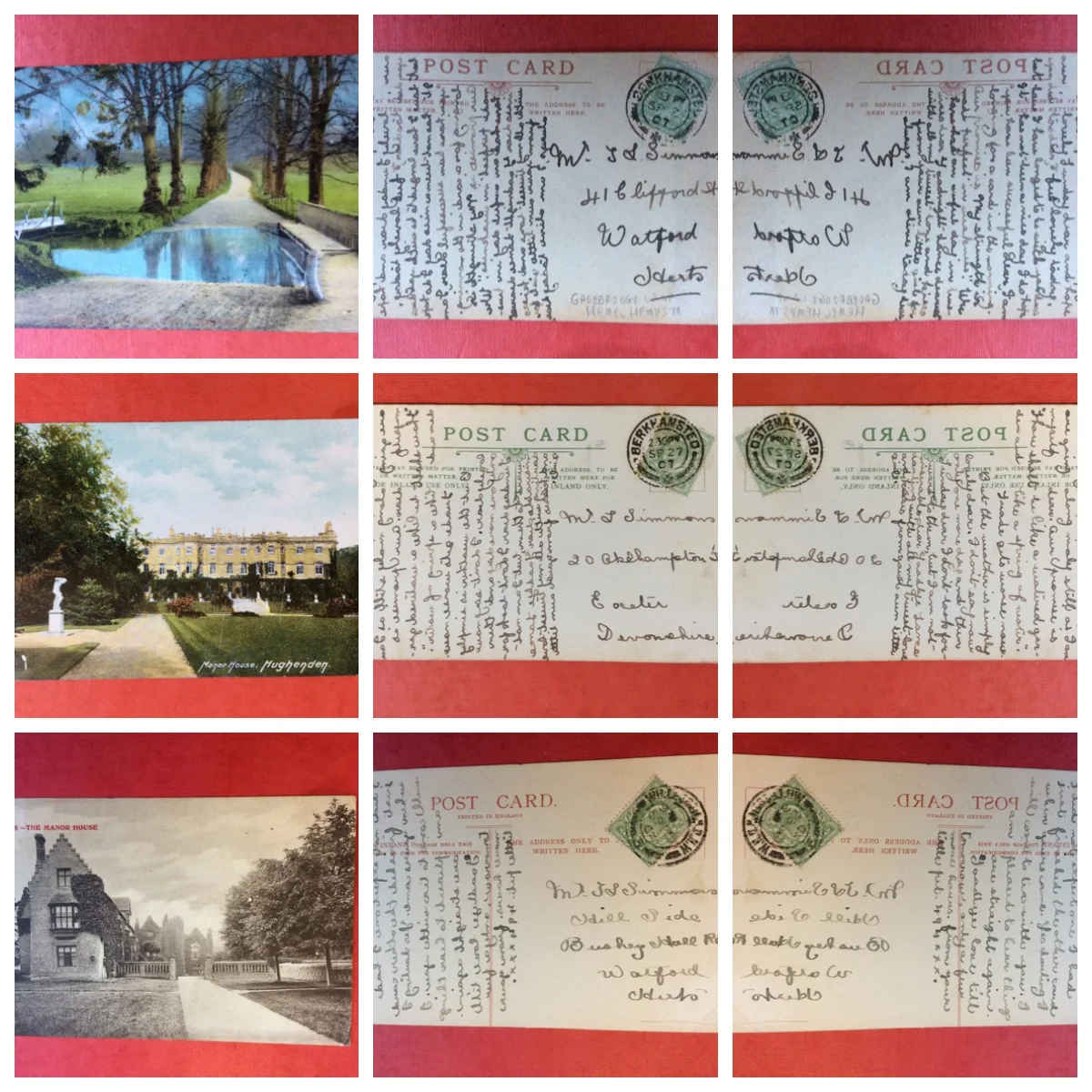
Mirror writing a love letter
This was a fascinating find on www.ebay.co.uk A series of three cards written in mirror writing by the same person to Thomas Lance Simmons. The cards are unsigned but soon after they were written Thomas married Jessie Louisa Smith and so you have to assume they were from her. They are love letters after all.
See the details at
Some families just seem to disappear
The 1908 card for Ernest Charles Cole is an example of where you can find the beginning but not the end. I could not find a marriage for Ernest's parents and I could not find deaths or marriages for most of the children. It is as if they all disappeared. Alien abduction? unlikely but perhaps something tragic or dramatic happened.
See details at
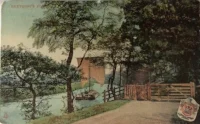
Two cards to the same family
Sometimes you come across multiple cards sent to the same person or the same family. The two cards sent to the Hartnall family were bought from the same market stall. This helped to track their identities although for one of them it wasn't possible to identify which of the three sisters it was sent to. These cards did pose another challenge because the names used in census records were different to those on the birth certificates.
See details at
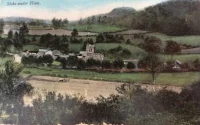
and

A new batch
Arrived today, a new batch of 19 postcards purchased from www.ebay.co.uk.
Sometimes the adventure takes you in an unexpected direction
Sometimes the card is simply what it says. Take for example the birthday card sent by James Sampson to his mother. There is nothing more to it than that. There does not seem to be anything remarkable about the family. On the other hand you can find yourself being drawn into an unexpected world. The card sent by someone unknown to an equally unknown Miss Young at first looked very unpromising. There was nothing to identify either person. That left the address that the card was sent to become the point of interest. Albert Villas turned out to be a private girls school run by a German lady and a lady with local connections. I wonder what qualifications were needed to operate a private girl's school in the latter part of the 19th century.
See details at